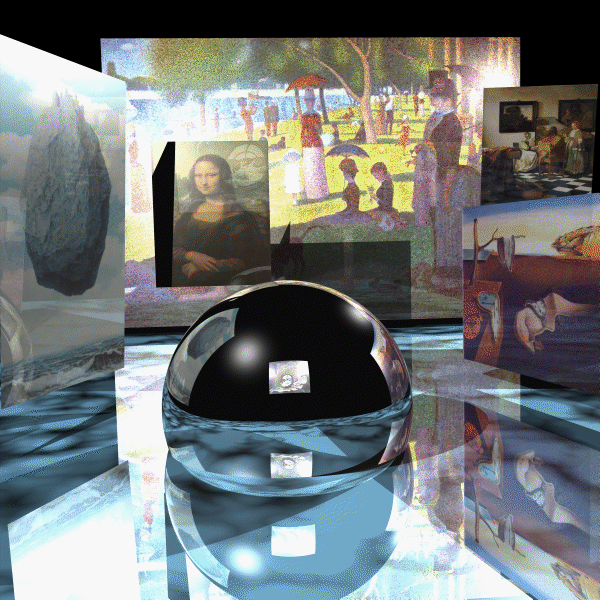
In the name of art, I've chosen the artists and pictures carefully, for what I feel would be their interest in the way computer graphics can represent the world. They are, from left to right:
Rene Magritte's "Le Chateau des Pyrenees". (1959) Magritte had a unique interest in the melding of image and reality.
DaVinci's La Joconde, best known as the Mona Lisa. (1503-06) DaVinci had one of the best eyes for perspective of all painters of his time...it's interesting to note that the features of the Mona Lisa may, in fact, be closer to DaVinci's own face than that of his model.
George Seurat's "Sunday Afternoon on the Island of La Grande Jatte". (1884-86) Seurat was one of the first to really experiment with the ability of a limited palette to represent every color in the rainbow. Witness that all of our images today seem to only have red, green, and blue in them :-)
Salvador Dali's "Persistence of Memory". (1931) Actually, I just always thought this print looked cool, so it got added in.
Jan Vermeer's "The Concert". (1665-66) Vermeer had one of the best eyes for the way light could fill a scene. His "Music Lesson" is used as the inspiration for the cover for Foley, Van Dam, et al. as a radiosity example. A similar effect is in this work. If you happen to see this painting in real life, please notify the authorities -- it was stolen from Boston's Gardner Museum in 1990.
Finally, in the gazing sphere (and a little bit in the reflection off the Mona Lisa), you can just make out M. C. Escher's Dewdrop (1948). Escher loved to study reflections, especially self portrait's in gazing spheres...I think he would love to see how a ray tracer can accurately model the reflections inherent in most of his work. Unfortunately, at this resolution, it is far too difficult to examine that work.